Press
Review
Double Huang Winners Open Up at Jordan Hall
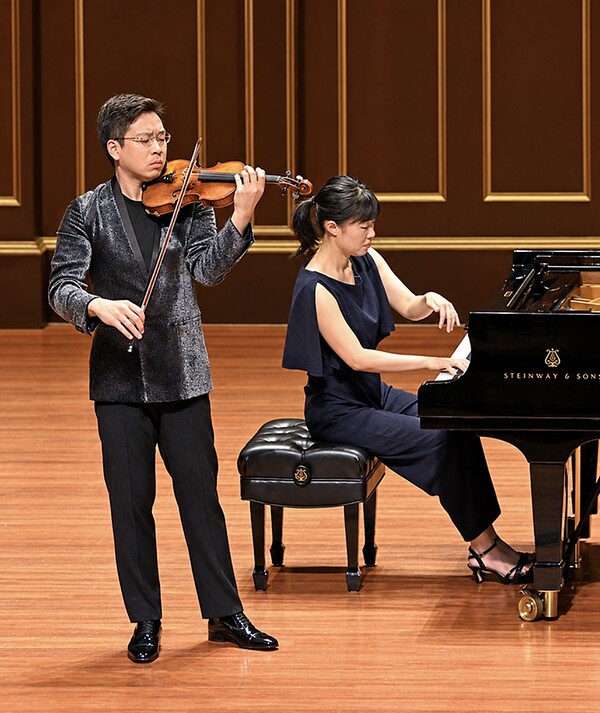
Those who braved the raging nor’easter for the first of this year’s Foundation for Chinese Performing Arts concerts were amply rewarded, as the fully collaborative concert by the accomplished 13-year partners violinist Paul Huang and pianist Helen Huang, positively enchanted.
Arvo Pärt’s crafted one of his most revered works, Spiegel im Spiegel, with intention and mathematic edge, yet it’s effect is mystical. Written in 1978, originally for these instruments, it has been transcribed for a passel—cello, viola, bass viol, flute, clarinet, horn, solo piano and organ and more.
The magic of this composition dawns subtly—first sounding simplistic, yet its power overtakes the listener within a few bars. Throughout, the violin sang a long, ascending melody that gradually expands outward, while the piano provided a succession of arpeggionated three-note chords—the tintinnabuli voice — part of Pärt’s signature—with each rising melodic phrase answered by a descending, almost mirrored phrase. Pärt’s melody initially consists of only two notes; with each subsequent phrase, another note is added, creating the sensation of the infinite unfolding. In this transformative piece, again and again, the melody returns to the central pitch of A. The composer wrote, “everything redundant must be left aside. Just like the composer has to reduce his ego when writing the music, the musician too must put his ego aside when performing the piece.” So, despite the mirrored sound, unlike Narcissus, this piece becomes selfless, both finite and expansive. In this performance, the work conveyed Pärt’s intent, with Paul Huang quietly soaring with signal steadiness on the magnificent 1742 “ex-Wieniawski” Guarneri del Gesu he has on loan through the auspices of the Stradivari Society of Chicago, while Helen Huang’s perfectly even tintinnabulous piano contributed mysticism.
The duo then moved without break into the Kreutzer sonata, Beethoven’s oft-performed classic, opus 47, in A major, initially intended for dedication to the Afro-European violinist Augustus Polgreen Bridgetower, who worked nearly feverishly with Beethoven and premiered this masterpiece with him in 1803. However, arguments between the two when out drinking led Beethoven to dedicated the work instead to Kreutzer, who never performed it and declared the sonata “unintelligible.” However, in the more-than 200 years since, consensus is otherwise– it has become a revered and standard classic. Here, the Adagio sostenuto—Presto easily began right after the Pärt. The meditative 16-bar Adagio spread out languidly, followed by the sprightly Presto, and throughout the first movement, the partners shone with fine phrasing and upbeat mood. The Andante con variazioni, rooted in F major, contributes five variations, with the third transitioning to F minor. This work displayed the musical partnership of the players in detail. The duo crafted clear differences in these bon mots– the first, playful, the second, a bit bouncier, the third, contemplative; the fourth, ornamental and light; and the final, peaceful and languid with its definitive coda. The breakneck Presto conveyed celebratory exuberance and consonant musicianship.
After a breather, the massive and difficult Saint-Saëns violin-piano sonata No. 1 in D Minor, Op. 75, written in the composer’s 50th year, capped the evening. One of the most challenging sonatas in the repertoire, it ranges from bold, bright and virtuosic to peaceful—and is said to encapsulate French elegance as well as Romantic intensity. Further, it almost magically presents a the illusion of two movements, though listed as four. And it certainly challenges the instrumentalists, this duo being more than up to it. As the turbulent initial theme of the Allegro agitato morphed into a lyrical and soothing second one, we were already bowled over. The Huangs segued into the Adagio with rapt intensity, allowing the scherzo-like Allegretto moderato to buoy the mood, before catching fire in the Allegro molto and impelling enthusiastic bravos. In all, a most satisfying rendition of this ebullient sonata.
The duo encored sweetly with the Heifetz adaptation of Stephen Foster’s, “I Dream of Jeannie, with the Light Brown Hair,” touchingly dedicating it to Foundation-founder Cathy Chan.
These major artists and inspiring collaborators should be welcomed back to Boston many times.